
Were the Pharisees Trying to Kill Yeshua?
- Yosher Ganon
- Apr 30
- 14 min read
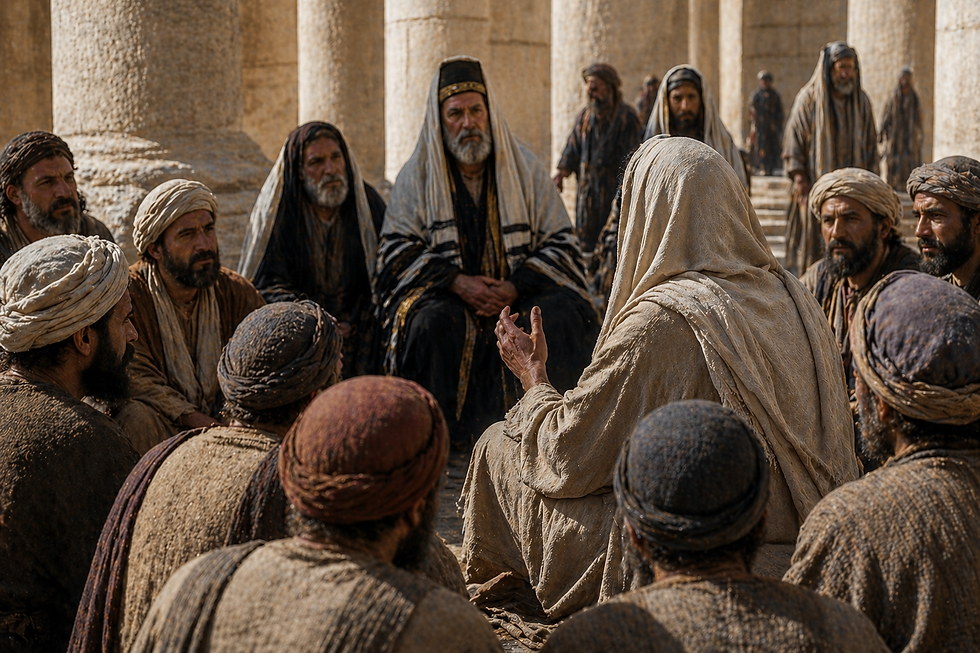
A Critical Examination of Matthew 12:14, Mark 3:6, and the Trial Narrative
Yosher Ganon | Hebrew House | 5786
A Critical Examination of Matthew 12:14, Mark 3:6, and the Trial Narrative
Introduction: The Question
A persistent misreading of the Gospel accounts claims that "all the Jews wanted Yeshua dead" and that "the Pharisees plotted his execution." This conclusion is typically built from a small cluster of verses—Matthew 12:14, Mark 3:6, Matthew 26:3–4, John 5:18, and John 11:45–53—read through later theological lenses that flatten Second Temple Judaism into a single, monolithic entity.
Such readings fail on historical, linguistic, and methodological grounds.
This article argues that:
1. The Greek vocabulary used for Pharisaic opposition does not specify assassination.
2. The Sadducean priestly elite—not the Pharisees—initiated and orchestrated Yeshua's arrest and death.
3. The trial narratives consistently violate Pharisaic halakhic principles while aligning with Sadducean political interests.
4. Later Christian polemics universalized elite Judean guilt onto "the Jews" as a whole, producing both theological distortion and real-world harm.
This is not an attempt to defend Judaism or Christianity as systems. It is a historical and textual examination that respects the sectarian diversity of Second Temple Judaism and refuses to collapse distinct groups into a single category.
I. The Vocabulary Question: ἀπόλλυμι and ἀποκτείνω
A. What the Gospels Say About Pharisaic Opposition
Matthew 12:14:
"But the Pharisees went out and took counsel against him, how they might destroy him."
Mark 3:6:
"The Pharisees went out and immediately held counsel with the Herodians against him, how to destroy him."
At first glance, English translations suggest explicit murderous intent. The Greek, however, requires closer attention.
B. ἀπόλλυμι (apollymi): Intent Without Specification
Both passages use the verb ἀπόλλυμι, whose semantic range includes:
· destroy
· ruin
· undo
· cause loss
· eliminate
· bring to nothing
While ἀπόλλυμι can refer to physical death in certain contexts, it does not inherently specify the means by which destruction occurs. It denotes intent to eliminate a perceived threat, not the mechanism—whether social, legal, political, or lethal.
This matters.
In Matthew and Mark, the verb appears in a deliberative construction ("they took counsel … in order to"), signaling intentional opposition. What it does not do is name execution, violence, or judicial killing as the specific means.
This does not deny that physical elimination may have been desired by some individuals; it does deny that the text specifies execution as the Pharisaic strategy or intent.
When the Gospel writers wished to specify lethal intent, they had precise vocabulary available—and used it for other actors.
C. ἀποκτείνω (apokteinō): Explicit Killing
When the Gospel writers intend to describe physical killing, they use a different verb.
Matthew 26:3–4:
"The chief priests and the elders of the people gathered in the palace of the high priest … and took counsel in order to arrest Yeshua by stealth and kill him."
Here the verb is ἀποκτείνω, which unambiguously denotes physical killing—the deprivation of bodily life. In narrative contexts, it consistently refers to lethal action.
D. Narrative Pattern
The Gospel writers distinguish opposition from execution through vocabulary. This distinction aligns with known sectarian roles in Second Temple Judea and reflects differing methods and motives.
II. Historical Context: Pharisaic Dispute vs. Sadducean Power
A. Yeshua Within the Pharisaic Interpretive World
Yeshua does not confront the Pharisees as an external heretic. He operates within their interpretive ecosystem—arguing Torah, Sabbath, purity, authority, and covenant faithfulness using shared methods and categories.
This is intra-Jewish dispute, not inter-religious conflict.
Within Pharisaic culture, opposition to a rival teacher typically involved:
· public argument
· discrediting interpretation
· limiting influence among the people
It did not normally mean assassination.
B. Yeshua as a "Third House": Independent Authority Within Pharisaic Categories
Yeshua operates within the Pharisaic interpretive world but not as a disciple of an established school. He functions as an independent authority claimant.
The term "third house" is used here heuristically—not to suggest institutional formalization (no "House of Yeshua" existed), but to describe his authority posture: independent of Hillel and Shammai while operating within their shared Torah framework.
Alignment with Hillel:
· Sabbath oriented toward human need (Mark 2:27: "The Sabbath was made for man")
· Compassion prioritized in Torah application (Matt 12:7: "I desire mercy, not sacrifice")
· Flexible purity boundaries (Mark 7:14–23: internal over external purity)
Divergence from both Hillel and Shammai:
This makes Yeshua more dangerous than an external heretic. He does not attack the Pharisaic system from outside; he reconfigures authority from within by claiming final interpretive authority independent of existing schools.
This explains why Pharisees sought to eliminate his influence (ἀπόλλυμι) without pursuing execution (ἀποκτείνω).
Appropriate Pharisaic responses to such a figure included:
5. Testing his halakha (public debate)
6. Exposing perceived flaws (discrediting his interpretation)
7. Limiting public platforms (reducing his influence)
8. Applying political pressure (consulting political allies like the Herodians)
This is precisely what the Gospel narratives describe:
· Pharisees test Yeshua repeatedly (Mark 10:2; Matt 22:15–22)
· They seek to trap him in contradictions (Luke 11:53–54)
· They consult political allies (Herodians, Mark 3:6) to limit his influence
What they do not show is:
· Pharisees convening a capital trial (that's the Sadducees, Matt 26:57–68)
· Pharisees handing Yeshua to Rome (that's the chief priests, Mark 15:1)
· Pharisees participating in execution proceedings (they are absent from trial narratives)
C. Capital Punishment and Pharisaic Restraint
Later rabbinic literature—though redacted in the third century—preserves Pharisaic legal trajectories already visible in Josephus and reflected in Gospel disputes. These texts consistently portray Pharisaic legal instincts as highly restrictive regarding capital punishment.
Mishnah Makkot 1:10:
"A Sanhedrin that puts a man to death once in seven years is called murderous. Rabbi Eliezer ben Azariah says: even once in seventy years."
Mishnah Sanhedrin 4:5:
"The more one cross-examines witnesses, the more praiseworthy, so that the accused may be acquitted."
These texts are used here as trajectory evidence—not as transcripts of first-century courtrooms. The Mishnah is a 3rd-century redaction, but it preserves Pharisaic legal priorities already visible in Josephus (*Antiquities* 18) and reflected in Gospel debates (e.g., witness requirements, Sabbath leniency). This trajectory stands in sharp contrast to the Gospel trial narratives.
The "Eighteen Decrees" Incident: Institutional Coercion, Not Assassination
Rabbinic tradition preserves a rare exception: the "eighteen decrees" episode (*b. Shabbat* 17a; t. Shabbat 1:16–17), in which Shammaites used armed coercion to force nationalist rulings during a formal legislative session.
Babylonian Talmud, Shabbat 17a:
"On that day, they placed a sword at the entrance [to the academy]. They said, 'Whoever wishes to enter, let him enter, but let no one leave.' On that day, they enacted eighteen decrees."
This incident is remembered as tragic and aberrant—"as grievous as the Golden Calf" (*Tosefta Shabbat* 1:16)—precisely because it violated Pharisaic norms.
Critical distinctions:
9. Institutional coercion ≠ extra-judicial murder (this occurred within a legislative session convened to decide binding communal law)
10. Forcing a vote ≠ executing opponents (coercion to pass legislation, not assassination afterward)
11. Remembered as aberrant, not normative (the tragedy is named precisely because it violated expectations)
No evidence exists of Pharisaic assassination campaigns against independent teachers operating outside formal legislative structures.
The "eighteen decrees" incident thus cannot be used to justify claims that Pharisees sought to assassinate Yeshua. The contexts are categorically different: institutional coercion during a binding vote vs. extra-judicial murder of an independent teacher.
By Yeshua's ministry, Shammaite influence was waning, and the Hillelite majority—dominant in Galilee—represented the accommodationist, non-violent trajectory that shaped post-70 rabbinic Judaism.
D. A Counter-Text: Luke 13:31
Luke 13:31:
"At that very hour some Pharisees came and said to him, 'Get away from here, for Herod wants to kill you.'"
This warning cannot be easily harmonized with the claim that Pharisees were actively plotting Yeshua's execution.
Alternative readings (strategic intimidation to drive him out of their territory, or a Lukan literary device to advance the journey motif) have been proposed, but the text itself gives no indication of duplicity. The simpler reading is that they genuinely alerted Yeshua to danger. This aligns with their later absence from the trial and their halakhic opposition to hasty capital punishment.
At minimum, this passage disrupts any claim of unified Pharisaic intent to kill.
III. The Trial Narratives: Who Acts, Who Is Absent
A. Who Initiates the Arrest?
Across the Synoptics, the actors are consistent:
· chief priests
· elders
· the high priest (Caiaphas)
Pharisees are notably absent as initiators.
B. Procedural Violations
The trial narratives violate every major safeguard associated with Pharisaic legal reasoning:
These violations align with Sadducean political expediency, not Pharisaic jurisprudence.
C. The Charge That Matters
Before Pilate, the charge is explicit:
Mark 15:2:
"Are you the King of the Jews?"
This is not blasphemy. It is sedition.
Rome executes Yeshua as a perceived rival king, not as a theological deviant. Crucifixion—a uniquely Roman punishment for political crimes—confirms the nature of the charge.
IV. Johannine Texts and Polemical Language
A. "The Jews" in John
In John's Gospel, "the Jews" (οἱ Ἰουδαῖοι) frequently functions as shorthand for hostile Judean authorities, particularly the Jerusalem establishment. This reflects post-70 CE intra-Jewish polemic, not an ethnic or covenantal category.
Reading John without this distinction produces historical error and theological distortion.
B. John 5:18: Narrator's Interpretation, Not Trial Charge
John 5:18 (ESV):
"This was why the Jews were seeking all the more to kill him, because not only was he breaking the Sabbath, but he was even calling Elohim his own Father, making himself equal with Elohim."
Problems with using this verse to prove Pharisaic assassination intent:
12. "The Jews" in John's Gospel refers to hostile authorities (often Judean leadership), not ethnic Jews as a whole—and in context usually means the Sadducean-dominated Temple establishment.
13. "Making himself equal with Elohim" is the narrator's theological interpretation, not a direct claim by Yeshua or a charge brought at trial. In Jewish agency categories, a shaliach (agent) speaks on behalf of the sender using first-person language—but is not ontologically equal to the sender (see John 5:19: "The Son can do nothing of his own accord").
14. Historical implausibility: If Yeshua had publicly claimed to be HaShem incarnate, why is this charge never brought at his trial? The trial focuses on messianic identity (political), not divine claims (theological).
John 5:18 reflects Johannine theological interpretation written decades after the events, not a historical transcript of first-century Pharisaic intent.
C. John 11:45–53 and the Council
John 11:47–48:
"So the chief priests and the Pharisees gathered the council and said, 'What are we to do? For this man performs many signs. If we let him go on like this, everyone will believe in him, and the Romans will come and take away both our place and our nation.'"
This passage explicitly names both chief priests and Pharisees in a council discussion. The logic driving the decision, however, is unmistakably Sadducean political realism.
John 11:49–50 (Caiaphas's response):
"You know nothing at all. Nor do you understand that it is better for you that one man should die for the people, so that the whole nation should not perish."
Caiaphas (a Sadducee) dominates the decision, and the logic is Sadducean realpolitik ("better one man die than the nation perish").
Some Pharisees likely acquiesced—whether reluctantly, pragmatically, or silently. But the Synoptic trial accounts show no Pharisees at the arrest or proceedings, and the procedural violations contradict Pharisaic halakhic priorities.
Presence in deliberation does not equal authorship of execution.
V. Why Judas Was Necessary
If authorities simply wanted Yeshua arrested, Judas was unnecessary—Yeshua taught publicly in the Temple.
What Judas provided was insider testimony regarding Yeshua's private messianic claims.
Matthew 16:13–20:
· Yeshua asks the disciples, "Who do you say that I am?"
· Peter answers: "You are the Messiah, the Son of the living Elohim."
· Verse 20: "Then he ordered the disciples not to tell anyone that he was the Messiah."
This is the betrayal.
Yeshua kept his messianic identity private to avoid Roman attention. Judas told the authorities what Yeshua claimed in private. The Sadducees now had a charge they could take to Rome: sedition (claiming kingship).
VI. Responsibility, Properly Assigned
A. Rome
Rome executed Yeshua for sedition. Crucifixion was a Roman punishment for political threats—specifically, rival kingship claims and insurrection.
B. The Sadducean Priesthood
The chief priests orchestrated the arrest, manipulated proceedings, and delivered Yeshua to Roman authority. They acted to preserve their power, position, and Temple system under Roman oversight.
This elite vanished entirely after 70 CE, when Rome destroyed the Temple and ended the sacrificial system on which Sadducean power depended.
C. The Pharisees
The Pharisees opposed Yeshua's authority claims and sought to neutralize his influence through debate, discrediting, and political pressure (ἀπόλλυμι). There is no evidence that they orchestrated or desired his execution (ἀποκτείνω) as a class.
The distinction in Greek vocabulary, the absence of Pharisees from trial narratives, the procedural violations of Pharisaic halakha, and the protective warning in Luke 13:31 all point in the same direction: Pharisaic opposition did not equal desire for execution.
D. "All the Jews"?
This claim is historically indefensible.
The Sadducean elite were a narrow aristocracy that vanished after 70 CE when the Temple was destroyed. Rabbinic Judaism—the living continuation of Second Temple Judaism—descends from the Pharisaic tradition, not from Yeshua's executioners.
Matthew 27:25 ("His blood be on us and on our children") is a Matthean redaction reflecting post-70 CE tensions, and in narrative context refers to the crowd gathered at Caiaphas's residence—the Sadducean elite and their supporters—not the Jewish people as a whole.
VII. Conclusion
Did all Jews want Yeshua dead?
No.
Did the Pharisees seek to assassinate Yeshua?
The evidence does not support that claim.
The Gospel narratives distinguish between opposition and execution through:
· Vocabulary (ἀπόλλυμι vs. ἀποκτείνω)
· Actors (Pharisees vs. chief priests/elders)
· Procedure (Pharisaic halakhic norms vs. Sadducean political manipulation)
Yeshua's death emerges from intra-Jewish sectarian conflict, elite political fear, and Roman enforcement—not from a unified Jewish rejection.
This distinction is not academic hair-splitting. It is necessary for:
· Historical honesty (respecting Second Temple sectarian diversity)
· Theological clarity (distinguishing Torah-faithful opposition from political collaboration with Rome)
· Rejection of harmful distortions that have echoed for centuries in anti-Jewish violence
The Pharisees were not the villains of Christian imagination.
Rome executed Yeshua.
The Sadducean priesthood orchestrated it.
And the flattening of this complex reality into "the Jews killed Christ" represents both historical error and theological failure.
Frequently Asked Questions
Q: Didn't the House of Shammai use violence against the House of Hillel?
A: Yes, in the "eighteen decrees" incident (~18–30 CE), Shammaites used armed coercion within a structured legislative vote to force through nationalist rulings, possibly resulting in violence. This was institutional coercion within a halakhic session convened to decide binding communal law—not assassination of independent teachers operating outside formal structures.
It is remembered as tragic and aberrant—"as grievous as the Golden Calf"—precisely because it violated Pharisaic norms. By Yeshua's ministry, Shammaite influence was waning, and the Hillelite majority (dominant in Galilee) represented the non-violent, accommodationist trajectory that shaped post-70 rabbinic Judaism.
The "eighteen decrees" incident cannot be used to justify claims that Pharisees sought to assassinate Yeshua. The contexts are categorically different: institutional coercion during a binding vote vs. extra-judicial murder of an independent teacher.
Q: Was Yeshua a Pharisee?
A: Yeshua operated within the Pharisaic interpretive world (Torah-centered, halakhic debates, Galilean context) and aligned more with Hillel than Shammai on key issues (Sabbath, compassion, purity). However, he claimed independent authority as HaShem's shaliach rather than submitting to existing schools—making him a "third house" rather than a member of Hillel or Shammai.
He was not attacking the Pharisaic system from outside; he was reconfiguring authority from within by claiming final interpretive authority independent of established schools. This made him more dangerous than an external heretic, but it does not mean Pharisees sought his execution.
Q: Why do Matthew 12:14 and Mark 3:6 say Pharisees wanted to "destroy" Yeshua?
A: The Greek word ἀπόλλυμι ("destroy") expresses intent to eliminate a threat without specifying method. In context, this means discrediting his teaching, limiting his influence, and applying political pressure—not execution.
When Gospel writers intend to describe killing, they use ἀποκτείνω (Matt 26:3–4; Mark 14:1), which is reserved for Sadducean plans. The vocabulary distinction aligns with different sectarian methods and motives.
Q: Doesn't John 11:47–53 implicate Pharisees in Yeshua's execution?
A: John names "chief priests and Pharisees" in a council, but Caiaphas (a Sadducee) dominates the decision, and the logic is Sadducean realpolitik ("better one man die than the nation perish").
Some Pharisees may have been present and even acquiesced, but the Synoptic trial accounts show no Pharisees at the arrest or proceedings, and the trial violates every major Pharisaic halakhic safeguard.
Presence in deliberation does not equal authorship of execution. The actors who orchestrate arrest, manipulate proceedings, and hand Yeshua to Rome are consistently identified as chief priests and elders—not Pharisees.
Q: What about John 5:18, which says "the Jews" wanted to kill Yeshua for making himself equal with Elohim?
A: John 5:18 reflects Johannine theological interpretation written decades after the events, not a historical transcript. Three key points:
15. "The Jews" in John is a post-70 CE polemical term for hostile authorities (usually Sadducean Temple establishment), not ethnic Jews.
16. "Making himself equal with Elohim" is the narrator's interpretation, not a charge brought at trial. Yeshua's shaliach language (speaking on behalf of HaShem) was misunderstood through later Greek philosophical categories.
17. Historical implausibility: If this was the real charge, why was it never mentioned at the trial? The actual charge before Pilate was messianic kingship (sedition), not divine claims (blasphemy).
Q: Isn't the Mishnah too late to use as evidence for first-century Pharisaic practice?
A: The Mishnah is a 3rd-century redaction, but it preserves Pharisaic legal trajectories already visible in Josephus (*Antiquities* 18) and reflected in Gospel debates.
We use the Mishnah as trajectory evidence, not as a transcript of first-century courtrooms. The consistent pattern—restrictive capital punishment, exhaustive witness examination, preference for acquittal—aligns with what we know of Pharisaic priorities from earlier sources.
The trial violations described in the Gospels contradict these trajectories at every point, suggesting Sadducean political manipulation, not Pharisaic jurisprudence.
Q: So the Pharisees were innocent and did nothing wrong?
A: No. The Pharisees fiercely opposed Yeshua's authority claims and sought to eliminate his influence through debate, discrediting, and political pressure.
What they did not do is:
· Orchestrate his arrest
· Convene the trial
· Hand him to Rome
· Participate in his execution
The distinction matters because:
18. Sectarian opposition ≠ collaboration with Rome
19. Debate and discrediting ≠ assassination
20. Presence in one council meeting ≠ authorship of execution
Pharisees opposed Yeshua. They did not execute him. Rome did—with Sadducean orchestration.
Sources Used
Primary Texts
· Synoptic Gospels (Matthew, Mark, Luke) and John
· Mishnah Sanhedrin 4:1, 4:5, 5:2, 7:5, 11:2 (used as Pharisaic trajectory evidence)
· Mishnah Makkot 1:10
· Mishnah Gittin 9:10
· Babylonian Talmud, Shabbat 17a
· Tosefta, Shabbat 1:16–17
· Mishnah Eduyot (witness testimony laws)
· Josephus, Antiquities of the Jews 18
Lexicons
· Arndt, William, Frederick W. Danker, Walter Bauer, and F. Wilbur Gingrich. A Greek-English Lexicon of the New Testament and Other Early Christian Literature (BDAG). 3rd ed. Chicago: University of Chicago Press, 2000.
· Brannan, Rick, ed. Lexham Research Lexicon of the Greek New Testament. Lexham Research Lexicons. Bellingham, WA: Lexham Press, 2020.
· Swanson, James. Dictionary of Biblical Languages with Semantic Domains: Greek (New Testament). Oak Harbor: Logos Research Systems, Inc., 1997.
Secondary Scholarship
· Bond, Helen K. Pontius Pilate in History and Interpretation. Society for New Testament Studies Monograph Series 100. Cambridge: Cambridge University Press, 1998.
· Brown, Raymond E. The Death of the Messiah: From Gethsemane to the Grave: A Commentary on the Passion Narratives in the Four Gospels. 2 vols. Anchor Bible Reference Library. New York: Doubleday, 1994.
· Cohen, Shaye J. D. From the Maccabees to the Mishnah. 2nd ed. Louisville: Westminster John Knox Press, 2006.
· Ehrman, Bart D. Lost Christianities: The Battles for Scripture and the Faiths We Never Knew. Oxford: Oxford University Press, 2003.
· Fredriksen, Paula. Yeshua of Nazareth, King of the Jews: A Jewish Life and the Emergence of Christianity. New York: Vintage Books, 2000.
· Mantel, Hugo. "Sanhedrin." In Encyclopaedia Judaica, 2nd ed., edited by Michael Berenbaum and Fred Skolnik, 14:836–839. Detroit: Macmillan Reference USA, 2007.
· Neusner, Jacob. The Rabbinic Traditions About the Pharisees Before 70. 3 vols. Leiden: Brill, 1971.
· Saldarini, Anthony J. Pharisees, Scribes and Sadducees in Palestinian Society: A Sociological Approach. Grand Rapids: Eerdmans, 1988; reprint, Grand Rapids: Eerdmans, 2001.
· Sanders, E. P. Judaism: Practice and Belief, 63 BCE–66 CE. London and Philadelphia: SCM Press and Trinity Press International, 1992.
· Winter, Paul. On the Trial of Yeshua. 2nd ed. Revised and edited by T. A. Burkill and Geza Vermes. Studia Judaica 1. Berlin: Walter de Gruyter, 1974.
Methodological Classification
· Direct textual claim: Gospel vocabulary distinction (ἀπόλλυμι vs. ἀποκτείνω used for different actors); trial procedural violations listed in Matthew 26, Mark 14–15, Luke 22–23
· Historical inference: Pharisaic absence from trial narratives = majority scholarly view (Sanders, Fredriksen, Bond, Brown); Yeshua as "third house" = textually grounded pattern (comparative halakha in Gospel debates)
· Trajectory evidence: Mishnah as Pharisaic legal continuity, attested in Josephus and visible in Gospel debates (witness requirements, Sabbath disputes, purity discussions)
· Theological construction: Yeshua's shaliach claim interpreted as intra-Pharisaic authority crisis (within Second Temple Jewish agency categories, not Nicene ontology)
· Discontinuity flagged: John's "the Jews" (οἱ Ἰουδαῖοι) = post-70 CE polemical category used for Jerusalem authorities, not ethnic designation; Matthew 27:25 = Matthean redaction reflecting post-70 tensions, not historical transcript of "all Israel"
End of Article
Comments