
Bearing One Another Without Control
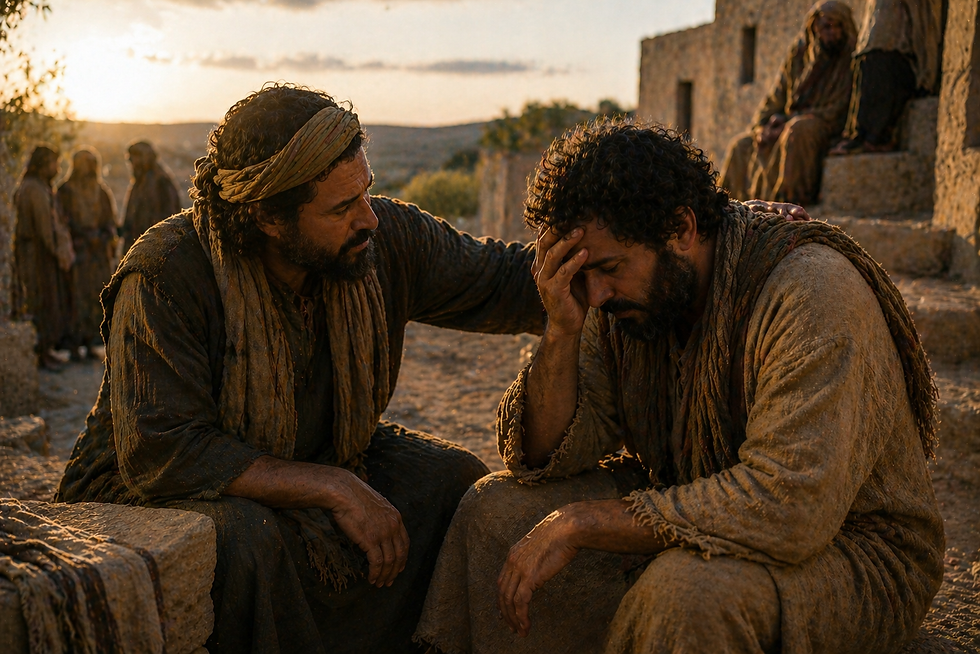
What It Really Means to Care for Each Other
Yosher Ganon | Hebrew House | 5786
The Problem We All Feel
Most of us have been hurt one of two ways.
Either someone tried to control us in the name of "accountability."
Or no one showed up when we were drowning.
Both leave scars.
Control feels like someone standing over you with a clipboard.Monitoring. Correcting. Managing your life like a project.
Silence feels like someone watching you fall and saying nothing."Not my business." "I don't want to interfere." "You'll figure it out."
Neither is covenant.Neither is love.
So what does it actually look like to carry one another the way Torah intends?
Torah Doesn't Let Us Do Either Extreme
In Leviticus 19, God says two things back-to-back:
"Don't go around spreading damaging speech.And don't stand by when your neighbor is bleeding."
That's not random.
One command protects people from meddling.The other protects people from neglect.
Between those two is the narrow road.
You are not allowed to gossip about people behind their backs.You are not allowed to ignore real harm happening in front of you.
Then comes the hard one:
"You shall surely reprove your neighbor."
That means: If something is truly wrong—you speak.
But it also says:"Don't sin while correcting."
So correction must be:
Face-to-face (not behind-the-back)
Not vengeful
Not humiliating
Not public theater
And it ends with:
"Love your neighbor as yourself."
Love is the frame.Not control.Not avoidance.
Love.
Generosity Without Control
In Deuteronomy 15, God commands open-handed generosity:
"Open your hand to your brother, to your needy and poor."
Open your hand.Give.Lend.Help.
What's missing?
There's no instruction to micromanage the poor.No demand for interrogation.No clause about "prove to me you deserve it."
Covenant generosity says:Make yourself available.
It does not say:Take over their life.
There's a difference between helping someone carry weight and grabbing the wheel.
Even Moses Couldn't Carry Everyone
Exodus 18 shows Moses trying to handle everything himself.
From sunrise to sunset, every problem came through him.Every question.Every dispute.Every decision.
It looked spiritual.It looked responsible.It was unsustainable.
His father-in-law Jethro tells him:
"This will destroy you. And it will exhaust the people."
So leadership gets distributed.
Not removed.Distributed.
Healthy authority in Torah:
Is shared
Is relational
Is based on character, not just position
Has limits
Control centralizes.Wisdom distributes.
Moses didn't sin by trying to carry everything.He just tried to carry what God never asked one man to carry.
A Story That Shows It
There's a story in 2 Kings about a woman who quietly builds a room for the prophet Elisha.
She doesn't demand attention.She doesn't ask for blessing.She just sees a need and acts.
Elisha offers to help her in return—maybe speak to the king on her behalf?
She says:
"I live among my own people."
Translation: I'm good. I didn't do this to get something back.
Later, the child Elisha promised her dies suddenly.
"Did I ask for a son? Didn't I tell you, 'Don't deceive me'?"
He doesn't shame her.He doesn't correct her tone.He doesn't defend himself.
He shows up.
He stays.He prays.He acts.
The child is raised.
That's covenant care.
Not controlling.Not abandoning.Showing up.
Yeshua Did This Too
Yeshua rebuked when necessary—especially religious leaders abusing power.
But he also:
Ate with tax collectors and sinners
Touched people others considered unclean
Sat at tables others avoided
He stayed close enough to restore.
Not close enough to control.Not distant enough to abandon.Close enough to restore.
Paul Explains the Balance
In Galatians 6, Paul uses two different Greek words:
Crushing burdens (βάρος, baros)—weight too heavy for one person.Normal loads (φορτίον, phortion)—the regular pack each person carries.
"Bear one another's crushing burdens.""But each person will carry their own normal load."
This is the wisdom:
If you carry someone's normal load for them, you steal their growth.
If you refuse to help with crushing weight, you abandon them.
Discernment matters.
Boundaries Still Exist
This teaching is not softness.
Torah has real boundaries.
There are cases where someone refuses correction.Cases where harm continues.Cases where separation becomes necessary.
Numbers 15 speaks of "high-handed" sin—deliberate, persistent defiance.Deuteronomy 17 outlines how serious violations are handled: witnesses, investigation, community accountability.
But separation is never meant to be:
Impulsive
Public humiliation
Fear-based control
A shortcut to avoid the hard work of restoration
And correction is never meant to be:
Ego-driven
Surveillance-based
Motivated by power
A way to replace someone's conscience
Covenant discipline protects the community.It does not feed the leader's need for control.
The Line That Changes Everything
Here's the test:
If your concern doesn't cost you relationship, it's probably control.
If your love never risks discomfort, it's probably avoidance.
That's how you know.
Control is cheap. You can correct from a distance.Avoidance is easy. You can stay silent and feel virtuous.
Bearing is costly.It requires proximity.It requires staying when it's messy.It requires speaking when it's uncomfortable.
What This Looks Like in Real Life
For You Personally
Speak when something truly matters.Not when you're annoyed. Not when someone's different. When real harm is happening.
Stay silent when it's about preference.Your way of doing things isn't the only way. Let people breathe.
Help when someone is drowning.When the weight is crushing—step in.
Step back when someone is learning to walk.When it's formative struggle—let them carry it.
For Leaders
Correct privately before publicly.Matthew 18 gives the pathway: one-on-one first, then bring others, then involve the community. In that order.
Earn trust before exercising authority.Proximity first. Relationship first. Then—and only then—correction.
Make restoration the goal, not punishment.Even in discipline, the aim is return.
Let people breathe around you.If people are smaller, more anxious, and more afraid after being around you—something is wrong.
For Communities
Be small enough to know each other.Proximity requires presence. You can't care for people you don't actually know.
Structured enough to share weight.The Exodus 18 model: distribute leadership so no one carries everything alone.
Gentle enough to receive it.If you can correct but can't be corrected, you're not in covenant community—you're in control.
The Real Goal
Covenant responsibility is not surveillance.
It is shared weight.
It means:
I see you.
I won't control you.
I won't abandon you.
I will stand with you.
That's harder than control.
Control feels productive.Quick decisions. Clear lines. Visible results.
Bearing feels slow.Quiet.Unimpressive.Like nothing is happening.
But bearing heals.
Control only postpones collapse.
A Final Word
Some of you fear control so much you've stopped speaking altogether.That's not humility. That's abdication.
Covenant love doesn't only comfort—it warns.
And some of you use proximity as permission to dominate.That's not leadership. That's manipulation.
Proximity earns permission to speak—not permission to control.
The narrow road runs between both ditches.
Closing
May we learn to carry one another without trying to control one another.
May we speak when needed and stay silent when wise.
May we notice what is near—and release what is not.
And may our shared life feel lighter because the weight is shared.
Word Count: ~1,500 words (down from 9,300)
Bearing One Another Yosher Ganon
Without Control
Covenant Responsibility After Return
Abstract
This article explores covenant responsibility as mutual obligation grounded in relational proximity rather than surveillance or abandonment. Drawing primarily from Leviticus 19:16-18, with supporting patterns from Deuteronomy 15, Exodus 18, and 2 Kings 4, the argument positions reproof and generosity as relational practices bounded by both action and restraint. The New Testament development in Galatians 6 and James 5 is read as continuity with Torah's communal ethic rather than replacement. The article acknowledges Second Temple diversity on correction and discipline, deliberately choosing a restoration-oriented trajectory aligned with prophetic mercy and Yeshua's table fellowship practice. Pastoral application addresses contemporary distortions: control disguised as accountability and avoidance disguised as respect for autonomy.
Key Claims
Leviticus 19:16-18 prohibits both destructive speech (rakhil) and passivity in the face of harm (standing idly by blood), commanding face-to-face reproof bounded by love of neighbor.
Covenant responsibility flows through proximate relationships, often formalized into positions of authority (Exodus 18), requiring both action when weight is crushing and restraint when it is formative (Galatians 6).
Second Temple communities varied widely in their approach to correction; this teaching follows a restoration-oriented trajectory rather than a sectarian purity model.
Bearing one another is not passive—it includes reproof, protection, and engaged presence—but it refuses surveillance, public shaming, and replacement of conscience.
Covenant boundaries remain real (Numbers 15:30-31, Deuteronomy 17); the question is how they function relationally rather than whether they exist.
Misuses to Reject
Control: Surveillance disguised as accountability, correction without relationship, spiritual management that replaces conscience.
Avoidance: Refusing the obligation to reprove out of fear of conflict, "live and let live" individualism that abandons people to harm.
Manipulation: Using proximity as license to dominate, weaponizing "concern" to justify constant correction, exploiting relational access for control.
Introduction: The Fear on Both Sides
Modern religious communities live between two opposite failures. On one side lies control—surveillance disguised as care, correction without relationship, spiritual management that replaces conscience. On the other side lies abandonment—silence when harm is happening, "not my business" spirituality, isolation disguised as respect for autonomy.
Both failures produce the same result: covenant community collapses. Control crushes people under the weight of constant monitoring. Abandonment leaves them alone when the weight becomes too heavy to bear. Neither reflects the Torah's vision for how Israel carries one another.
This tension is not new. It runs through Scripture, through Second Temple debates, through rabbinic wrestling with the limits of reproof, and into our own struggles to build communities that neither dominate nor neglect. The question before us is not whether to speak or stay silent, but how to carry one another without slipping into control or abandonment.
The answer lies in what we might call proximate responsibility—covenant obligation shaped by nearness: what you can actually see, know, and carry in relationship. This is covenant responsibility as shared weight, not surveillance.
Part I: Torah's Framework — Leviticus 19:16-18
The Dual Prohibition
Leviticus 19:16-18 provides the Torah foundation for mutual responsibility within covenant community:
"You shall not go about as a talebearer among your people; you shall not stand idly by the blood of your neighbor. You shall not hate your brother in your heart; you shall reprove your neighbor, and not bear sin because of him. You shall not take vengeance nor bear a grudge against the sons of your people, but you shall love your neighbor as yourself: I am Yahweh."
This passage operates as a tightly linked unit. It begins with two opposite prohibitions:
"You shall not go about as a talebearer" (לֹא תֵלֵךְ רָכִיל, lo telekh rakhil)
"You shall not stand idly by the blood of your neighbor" (לֹא תַעֲמֹד עַל דַּם רֵעֶךָ, lo ta'amod al dam re'ekha)
The first prohibition addresses destructive speech—רָכִיל (rakhil), often translated "talebearer" or "slanderer," refers to speech that harms reputation and destabilizes covenant community.1 This is not mere gossip; it is speech that functions to undermine trust, create factions, and damage social cohesion.
The second prohibition addresses passivity in the face of harm. The phrase עַל דַּם רֵעֶךָ (al dam re'ekha), "over the blood of your neighbor," points to the sharpest case: life-threatening danger. You may not stand by while your neighbor's life is at stake.2
These two prohibitions set boundaries on opposite failures: destructive, destabilizing speech on the one hand, and culpable passivity in the face of serious harm on the other.
The Command to Reprove
Verse 17 introduces the positive command:
"You shall not hate your brother in your heart; you shall reprove your neighbor [הוֹכֵחַ תּוֹכִיחַ אֶת עֲמִיתֶךָ, hokheach tokhiach et amitekha], and not bear sin because of him."
The infinitive absolute construction (הוֹכֵחַ תּוֹכִיחַ, hokheach tokhiach) emphasizes obligation: "you shall surelyreprove." This is not optional. Reproof functions within this unit as the covenant mechanism for addressing harm without devolving into hatred, vengeance, or public shaming.
The qualifying phrase, וְלֹא תִשָּׂא עָלָיו חֵטְא (velo tissa alav chet), "and not bear sin because of him," has been variously interpreted. A compelling synthesis of rabbinic readings and modern scholarship is that it protects both parties: the one reproving must not sin in the process (through vindictiveness, public shaming, or vengeance), and the one being reproved remains responsible for their own response.3 Others read it as warning that failure to reprove can make you complicit in the sin; either way, the clause places moral limits on how reproof is done and why it is done.
This structure establishes that reproof must be:
Relational (face-to-face, not behind-the-back)
Limited (bounded by concern for the other's good, not self-serving)
Just (free from vengeful motives or hatred)
Love as the Governing Frame
Verse 18 concludes the unit:
"You shall not take vengeance nor bear a grudge against the sons of your people, but you shall love your neighbor as yourself: I am Yahweh."
Love of neighbor (וְאָהַבְתָּ לְרֵעֲךָ כָּמוֹךָ, ve'ahavta lere'akha kamokha) is not sentiment but covenant responsibility—the obligation to pursue another's good as you would your own. This frame governs both the prohibition of talebearing and the prohibition of standing idle. Love means neither meddling nor neglect. It means proximate engagement that respects the other's dignity while refusing to abandon them to harm.
Part II: Extending the Principle — Deuteronomy 15:7-11
Open-Handed Generosity
While Leviticus 19 focuses on speech and reproof, Deuteronomy 15 extends covenant responsibility into the economic realm:
"If there is a poor man among you, one of your brothers, in any of your towns in your land which Yahweh your Elohim is giving you, you shall not harden your heart, nor close your hand from your poor brother; but you shall freely open your hand to him, and shall generously lend him sufficient for his need in whatever he lacks... For the poor will never cease to be in the land; therefore I command you, saying, 'You shall freely open your hand to your brother, to your needy and poor in your land.'"— Deuteronomy 15:7-8, 11
The repeated verb פָּתֹחַ תִּפְתַּח (patoach tiftach), "open you shall open," is an emphatic construction demanding active generosity. This is not optional charity; it is commanded covenant obligation.4
Now, Deuteronomy as a whole structures economic life through debt release cycles (Deut 15:1-6), kinship obligations, and Jubilee principles. This happens inside covenant expectations, not in a vacuum of modern liberal autonomy. However, this command foregrounds open-handedness; oversight mechanisms aren't the focus of this passage. The text does not instruct the giver to manage the poor person's life, to interrogate their worthiness, or to control how resources are used.
Bearing Without Managing
The principle here extends beyond economics: covenant responsibility means making yourself available to carry what your neighbor cannot carry alone, without assuming control over their choices. This is bearing without managing.
In contemporary terms, this might look like:
Offering financial help without demanding a full accounting of how they got into difficulty
Providing childcare without critiquing every parenting decision
Standing with someone in crisis without taking over their life
The limit is covenant itself: generosity operates inside shared norms, not in a relativistic vacuum. But within those norms, the emphasis is on giving access, not controlling outcomes.
Part III: Structural Wisdom — Exodus 18:13-26
The Unsustainable Weight
Exodus 18 provides a narrative example of how covenant responsibility must be distributed, not centralized:
"It came about the next day that Moses sat to judge the people, and the people stood about Moses from the morning until the evening. Now when Moses' father-in-law saw all that he was doing for the people, he said, 'What is this thing that you are doing for the people? Why do you alone sit as judge and all the people stand about you from morning until evening?'... Moses' father-in-law said to him, 'The thing that you are doing is not good. You will surely wear out, both yourself and these people who are with you, for the task is too heavy for you; you cannot do it alone.'"— Exodus 18:13-14, 17-18
Jethro's critique is not moral but prudential. He does not accuse Moses of sin, pride, or control. He simply observes that the system is unsustainable. Moses will "wear out" (נָבֹל תִּבֹּל, navol tibol), and so will the people.
This is critical: bearing everything alone is not faithfulness. It is a structural failure that harms both the one carrying and those waiting to be served.
Distributed Authority
Jethro's solution is to distribute authority through a graded system:
"Furthermore, you shall select out of all the people able men who fear Elohim, men of truth, those who hate dishonest gain; and you shall place these over them as leaders of thousands, of hundreds, of fifties and of tens. Let them judge the people at all times; and let it be that every major dispute they will bring to you, but every minor dispute they themselves will judge. So it will be easier for you, and they will bear the burden with you."— Exodus 18:21-22
This is not a rejection of structure or authority. It is the formalization of authority that anchors itself in proven character and local trust, even as it creates deliberate administrative structure. Notice the qualifications:
Able men (אַנְשֵׁי חַיִל, anshei chayil)—competent, capable
Who fear Elohim (יִרְאֵי אֱלֹהִים, yir'ei Elohim)—covenant loyalty
Men of truth (אַנְשֵׁי אֱמֶת, anshei emet)—integrity
Who hate dishonest gain (שֹׂנְאֵי בָצַע, son'ei vatza)—not motivated by profit
In Torah's ideal internal structures, authority is grounded in character and relationship, not arbitrarily imposed. The system recognizes tribal and clan realities while also creating formal administrative roles ("place them over..."). This is both organic and structural.
Proximity Formalized into Position
The principle here is not "proximity instead of position" but "proximity formalized into position." Good structures recognize relational realities and build on them. In our contemporary terms, bad structures impose top-down hierarchies that ignore proximity and replace conscience with compliance.
Moses' model shows that authority in Torah is:
Distributed (no single bottleneck)
Relational (grounded in proven character and trust)
Scalable (appropriate to the size and complexity of the community)
Limited (only the difficult cases escalate; most are handled locally)
This prevents both the collapse of lone-ranger leadership and the imposition of distant, detached management.
Part IV: Narrative Pattern — The Shunammite Woman and Elisha (2 Kings 4:8-37)
Mutual Bearing Without Management
The story of the Shunammite woman and Elisha provides a narrative demonstration of proximate responsibility that neither controls nor abandons. The text does not use "bearing" terminology—this is a pattern we are drawing out, not explicit inner-biblical language.
Stage 1: Noticing and Providing (vv. 8-17)
The woman notices Elisha passing through regularly and takes initiative:
"Now there came a day when Elisha passed over to Shunem, where there was a prominent woman, and she persuaded him to eat food. And so it was, as often as he passed by, he turned in there to eat food. She said to her husband, 'Behold now, I perceive that this is a holy man of Elohim passing by us continually. Please, let us make a little walled upper chamber and let us set a bed for him there, and a table and a chair and a lampstand; and it shall be, when he comes to us, that he can turn in there.'"— 2 Kings 4:8-10
Notice what she does not do:
She does not demand Elisha's attention or teaching
She does not ask for payment or blessing in return
She does not use hospitality as leverage for spiritual access
She simply sees a need (a traveling prophet with no place to stay) and acts.
When Elisha tries to reciprocate by offering political favor, she declines:
"Then he said to him, 'Say now to her, "Behold, you have been careful for us with all this care; what can I do for you? Would you be spoken for to the king or to the captain of the army?"' And she answered, 'I live among my own people.'"— 2 Kings 4:13
"I live among my own people" (בְּתוֹךְ עַמִּי אָנֹכִי יֹשֶׁבֶת, betokh ami anokhi yoshevet)—she is stable, embedded in community, not seeking external intervention. She provided because she saw, not because she needed.
This is costly hospitality that strengthens covenant life, enacted without expectation of return.
Stage 2: Crisis and Confrontation (vv. 18-28)
The child Elisha promised her dies suddenly:
"When the child was grown, the day came that he went out to his father to the reapers. And he said to his father, 'My head, my head.' And he said to his servant, 'Carry him to his mother.' When he had taken him and brought him to his mother, he sat on her lap until noon, and then died."— 2 Kings 4:18-20
Her response is direct—she lays him on Elisha's bed and goes immediately to the prophet. When she reaches him, her words are raw:
"Then she said, 'Did I ask for a son, my lord? Did I not say, "Do not deceive me"?'"— 2 Kings 4:28
Notice what she does not do:
She does not apologize for her grief
She does not spiritualize her pain
She does not soften her accusation
And notice what Elisha does not do:
He does not rebuke her tone
He does not correct her theology
He does not defend himself
He simply responds. This is bearing grief without managing it.
Stage 3: Presence and Intercession (vv. 29-37)
Elisha first sends Gehazi with his staff, but the woman refuses delegation:
"As Yahweh lives and as you yourself live, I will not leave you."— 2 Kings 4:30
She insists on Elisha's presence, not just his proxy. When the staff fails to revive the child, Elisha comes himself:
"When Elisha came into the house, behold the child was dead and laid on his bed. So he entered and shut the door behind them both and prayed to Yahweh. And he went up and lay on the child, and put his mouth on his mouth and his eyes on his eyes and his hands on his hands, and he stretched himself on him; and the flesh of the child became warm."— 2 Kings 4:32-34
This is embodied prophetic intercession—invoking divine power through physical engagement. It requires hispresence, not distant management. The miracle happens through proximate engagement.
The Pattern
The story demonstrates mutual bearing:
The woman bears Elisha's need without controlling his ministry
Elisha bears her grief without managing her response
Neither one dominates the other—both stay proximate, both act when needed
Part V: Second Temple and Rabbinic Perspectives
Diversity in Approach
Second Temple Judaism reflects diverse approaches to communal responsibility and correction. On one end of the spectrum, sectarian communities like Qumran practiced intensive internal monitoring, public rebuke, and expulsion for violations.5 The Community Rule (1QS) prescribes detailed regulations for reproof, punishment, and exclusion, reflecting a community deeply concerned with purity boundaries and covenantal separation.
On the other end, wisdom and prophetic traditions tended to emphasize mercy and relational ethics alongside justice. These aren't clean camps: prophetic literature includes severe rebuke and warnings of exile, and wisdom literature can endorse hard consequences. The point is not "nice versus strict" but which mechanisms a community foregrounds—exclusion and policing, or restoration and reintegration. Hosea 6:6 and Micah 6:8 foreground covenant loyalty expressed in mercy and justice, critiquing boundary-keeping when it becomes a substitute for faithfulness.
The teaching here follows the latter trajectory—not because the former is entirely unbiblical, but because the relational foundation must precede structural discipline. Without proximate relationship, correction becomes control. Without presence, boundaries become exile.
Rabbinic Wrestling with Reproof
The later rabbinic tradition wrestled extensively with the limits of reproof. Mishnah Avot 1:6 counsels:
"Provide yourself with a teacher, acquire for yourself a companion, and judge every person favorably."
This reflects a relational posture that makes correction safer and more truthful: you need a teacher (authority grounded in relationship), a companion (mutual accountability), and a posture of generosity toward others. This is wisdom counsel, not halakhic requirement, but it illuminates the relational conditions under which reproof can function without sliding into control.
Talmud Bavli Arakhin 16b debates how far reproof should go:
"How far does the mitzvah of reproof extend? Rav said: Until the one being reproved strikes you. Shmuel said: Until he curses you. Rabbi Yochanan said: Until he rebukes you in return."6
The debate reveals that even those who took reproof seriously recognized limits. None said, "Until they obey." All acknowledged that there comes a point where reproof becomes counterproductive—where persistence crosses into harassment, where concern becomes control.
This rabbinic conversation, though post-70 CE and not authoritative for this community, reflects ongoing Jewish wrestling with the tension Leviticus 19 creates: How do you fulfill the obligation to reprove without sliding into surveillance or domination?
Part VI: Yeshua and the New Testament Trajectory
Yeshua's Practice
Yeshua's ministry reflects the Leviticus 19 ethic consistently. He rebukes openly when necessary (Matthew 23, the scribes and Pharisees)—whatever one does with Matthew 23 historically, it functions as prophetic indictment aimed at public leadership failure, not as a template for ordinary peer-to-peer correction. But he also practices radical proximity—eating with tax collectors and sinners (Mark 2:15-17), touching the unclean (Mark 1:40-45), and refusing to condemn the woman caught in adultery (John 8:1-11).7
His table fellowship is particularly instructive. In first-century Jewish context, meals were boundary-markers and status signals. Yeshua's practice reconfigured those signals toward restoration rather than exclusion—staying close enough to speak, close enough to be heard, close enough to restore.8
This is bearing without abandonment and correction without control.
Galatians 6:1-5 — Two Kinds of Bearing
Paul develops this ethic in Galatians 6:
"Brothers, even if anyone is caught in any trespass, you who are spiritual, restore such a one in a spirit of gentleness; each one looking to yourself, so that you too will not be tempted. Bear one another's burdens [τὰ βάρη, ta bare], and thereby fulfill the law of Messiah. For if anyone thinks he is something when he is nothing, he deceives himself. But each one must examine his own work, and then he will have reason for boasting in regard to himself alone, and not in regard to another. For each one will bear his own load [τὸ ἴδιον φορτίον, to idion phortion]."
Paul uses two different Greek words for "bearing":
βάρος (baros, v. 2)—a crushing weight, a burden too heavy for one person to carry alone
φορτίον (phortion, v. 5)—a normal pack, the regular load each person is responsible to carry
This distinction is lexically sound and widely recognized.9 Paul is not contradicting himself. He is saying: step in when the weight is crushing (βάρος), but avoid over-functioning when it is the person's own ordinary load (φορτίον)—work that may be formative rather than crushing.
The verb "restore" (καταρτίζετε, katartizete) is active—it means to mend, repair, set right, like mending a fishing net or setting a broken bone.10 Gentleness is the manner, but action is required. This is not "leave them alone until they figure it out." It is "engage gently, stay present, speak truth, work toward restoration."
Paul's addition—"each one looking to yourself, so that you too will not be tempted" (v. 1)—guards against self-righteousness. The one who corrects must remain aware of their own vulnerability. This prevents the reprover from positioning themselves as superior, which would slide into control.
For a Torah-centered reading, "the law of Messiah" (τὸν νόμον τοῦ Χριστοῦ, ton nomon tou Christou) can coherently be read (within a Torah-centered framework) as Torah interpreted and embodied through Messiah, not a parallel law code replacing Torah.11 Paul echoes Leviticus 19:18—love your neighbor. That has not changed. Yeshua brings it into sharper focus.
James 5:19-20 — Bringing Back the Wandering
James applies the same ethic:
"My brothers, if any among you strays from the truth and one turns him back, let him know that he who turns a sinner from the error of his way will save his soul from death and will cover a multitude of sins."
The focus is on turning back (ἐπιστρέψῃ, epistrepsē)—the language of teshuvah, return. The goal is restoration, not exclusion.
However, the text does not explicitly require pre-existing trust. That is a pastoral safeguard we add to prevent abuse. In a context where spiritual authority has been weaponized, we must assume that effective correction happens inside trusted relationships. Without trust, the same language becomes coercion.
This is a legitimate pastoral hedge, even if not an explicit textual requirement. The alternative—allowing "bringing back the wandering" to be used by anyone, in any manner, toward anyone—produces spiritual abuse.
Part VII: Covenant Boundaries Are Real
The Necessity of Discipline
Bearing one another does not eliminate covenant boundaries. Torah includes both relational ethics (Leviticus 19) and judicial structures (Deuteronomy 17). Both are necessary.
Numbers 15:30-31 addresses high-handed, defiant sin:
"But the person who does anything defiantly [בְּיָד רָמָה, beyad ramah], whether he is native or an alien, that one is blaspheming Yahweh; and that person shall be cut off from among his people. Because he has despised the word of Yahweh and has broken His commandment, that person shall be completely cut off; his guilt will be on him."
This is not stumbling—it is persistent, defiant refusal to turn. The wider covenant story and the Prophets consistently hold out teshuvah, even where individual texts speak sharply of being cut off. Torah's covenant narrative prefers restoration where repentance is possible, but it also names cases of defiant rupture where the community's protection takes priority.
Deuteronomy 17:2-7 outlines judicial procedures for serious covenant violations, including required witnesses (Deut 19:15), investigation, and community accountability. These are not optional. Covenant community requires structure, not just sentiment.
The question is not whether boundaries exist, but how they function. The teaching here emphasizes that:
Rebuke without relationship becomes control
Boundaries without presence become exile
Consequences without restoration become punishment
This does not erase cases of necessary separation; it clarifies that separation should not be used as a shortcut for avoidance when restoration is actually possible.
Social removal protects the community; return is possible when genuine turning occurs, but it is not guaranteed. The process involves family, elders, and community—not isolated, unilateral action.
Balancing Correction and Presence
The balance required is this:
If your concern doesn't cost you relationship, it's probably control.But if your love never risks discomfort, it's probably avoidance.
Bearing one another is not passive. It includes:
Speaking when someone is genuinely lost
Naming harm when it's happening
Protecting the vulnerable even when awkward
Staying engaged when someone walks away from covenant faithfulness
But it also refuses:
Constant surveillance
Public shaming disguised as accountability
Spiritual policing driven by fear of contamination
Replacing someone's conscience with external management
The difference is relational: correction within trusted relationship becomes healing. Correction withoutrelationship becomes control.
Some people fear control so much that they refuse the mitzvah of reproof. That isn't humility; it's abdication. Covenant love doesn't only comfort—it warns.
And conversely: proximity earns permission to speak, not permission to dominate.
Part VIII: Practical Application
For Individuals
Diagnostic questions:
Where have I experienced control disguised as care?
Where have I experienced silence that felt like abandonment?
Who am I close enough to actually bear?
Am I avoiding necessary correction in the name of "not being controlling"?
Practices:
Notice what is near — You are not responsible for everyone, but you are responsible for someone. Who is proximate to you? Who can you see?
Speak without shaming — If correction is needed, do it face-to-face, privately when possible, with the goal of restoration.
Stay present without fixing — Sit with people in grief, crisis, or confusion without offering premature solutions or platitudes.
Protect without dominating — Create boundaries that guard the vulnerable without controlling their choices.
For Leaders
Leadership exists to reduce fear, not manage it. In contexts where fear of leaders or social sanction has been weaponized, leaders must deliberately practice:
Proximity before correction — Earn the right to speak by staying close
Private before public — Matthew 18:15-17 provides the escalation pathway: go privately first, then bring witnesses (echoing Deut 19:15), then involve the community
Restoration as the goal — Even in discipline, the aim is return, not permanent exclusion
Diagnostic questions for leaders:
Do people feel freer or smaller after being around you?
Do you correct publicly what should be handled privately?
Do you use "accountability" language to justify control?
Do people come to you, or do you have to pursue them?
The test case:What if someone is teaching something historically indefensible? What if someone is causing real division? What if someone refuses correction?
This framework does not mean avoiding structure or consequences. It means:
Start with proximity — private conversation, relationship-first approach (Matthew 18:15)
Escalate if needed — bring in witnesses (Matthew 18:16, echoing Deuteronomy 19:15), formalize accountability
Maintain restoration as the goal — even in boundaries, the path back remains open when genuine turning occurs
But if someone persistently refuses correction and harms the community, Torah provides for boundaries. The questions remain: Have we earned the right to speak? Have we stayed proximate? Have we preserved dignity even in discipline?
For Communities
Communities must resist two opposite errors:
Authoritarian control — heavy surveillance, public shaming, fear-based compliance
Passive neglect — "live and let live" individualism that refuses to speak even when harm is clear
The alternative is proximate accountability:
Small enough to know each other
Structured enough to distribute weight
Relational enough to speak truth
Humble enough to receive correction
This requires intentional practices:
Regular gatherings — proximity requires presence
Distributed leadership — weight must be shared (Exodus 18 model)
Clear processes — how does correction happen? Who is involved? What is the pathway for restoration?
Cultural resistance to shame — reproof is not public spectacle; it is relational engagement
Conclusion: Shared Weight, Not Surveillance
Covenant responsibility is not optional. Leviticus 19:17 commands reproof. Deuteronomy 15 commands generosity. Exodus 18 requires distributed leadership. Galatians 6 calls for mutual bearing. James 5 demands engagement with the wandering.
But the manner matters as much as the mandate.
Control crushes people. It monitors without relationship, corrects without proximity, and replaces conscience with compliance. It produces either resentful submission or reactive rebellion.
Abandonment leaves people alone. It refuses to speak when harm is happening, hides behind "not my business" spirituality, and isolates under the guise of respect for autonomy. It produces despair, drift, and collapse.
The Torah way is neither. It is proximate responsibility—noticing what is near, speaking without shaming, staying present without fixing, protecting without dominating. It is bearing one another without trying to control one another.
This is harder than control. Control is quick and feels productive. Bearing is slow and often feels like nothing is happening. But bearing heals. Control just postpones collapse.
The anchor line stands:
Covenant responsibility is shared weight, not surveillance.
May we learn to carry one another without trying to control one another.May we speak when needed and stay silent when wise.And may our shared life feel lighter because it is shared.
Endnotes
Bibliography
Primary Sources
The Hebrew Bible (Masoretic Text)Septuagint (LXX)New Testament (NA28 Greek Text)Mishnah (ed. H. Danby)Talmud Bavli (Steinsaltz Talmud)Sifra (Torat Kohanim)Dead Sea Scrolls (1QS Community Rule, Damascus Document)
Reference Works
Bauer, W., F.W. Danker, W.F. Arndt, and F.W. Gingrich. A Greek-English Lexicon of the New Testament and Other Early Christian Literature (BDAG). 3rd ed. Chicago: University of Chicago Press, 2000.
Louw, Johannes P., and Eugene A. Nida. Greek-English Lexicon of the New Testament. New York: United Bible Societies, 1989.
Secondary Sources
Hays, Richard B. The Letter to the Galatians. NIB. Nashville: Abingdon, 2000.
Levine, Baruch. Leviticus. JPS Torah Commentary. Philadelphia: Jewish Publication Society, 1989.
Milgrom, Jacob. Leviticus 17-22. Anchor Bible Commentary. New York: Doubleday, 2000.
Sanders, E.P. Jesus and Judaism. Philadelphia: Fortress, 1985.
Vermes, Geza. The Complete Dead Sea Scrolls in English. Rev. ed. London: Penguin, 2004.
Weinfeld, Moshe. Deuteronomy 1-11. Anchor Bible Commentary. New York: Doubleday, 1991.
Footnotes
On רָכִיל (rakhil) as destructive speech within covenant community, see Jacob Milgrom, Leviticus 17-22, Anchor Bible Commentary (New York: Doubleday, 2000), 1653-1654. Milgrom notes that rakhil goes beyond private gossip to include speech that harms social cohesion and trust. ↩
On the interpretation of "standing by the blood of your neighbor," see Baruch Levine, Leviticus, JPS Torah Commentary (Philadelphia: JPS, 1989), 131. Levine argues that this refers to failing to act when someone's life is in danger, not merely avoiding bloodshed oneself. ↩
On the phrase "and not bear sin because of him," rabbinic interpretation is divided. Rashi understands it as protecting the reprover from sinning through excessive rebuke. Ramban reads it as protecting both parties—the reprover from harsh methods and the reproved from being shamed publicly. See Sifra on Leviticus 19:17 and the summary in Milgrom, Leviticus 17-22, 1654-1655. ↩
On the emphatic construction פָּתֹחַ תִּפְתַּח (patoach tiftach), see Moshe Weinfeld, Deuteronomy 1-11, Anchor Bible Commentary (New York: Doubleday, 1991), 230-232. The infinitive absolute construction intensifies obligation. ↩
On Qumran's disciplinary practices, see the Community Rule (1QS) 5:24-6:1, which prescribes expulsion for various infractions and requires public confession for minor violations. See translation and commentary in Geza Vermes, The Complete Dead Sea Scrolls in English, rev. ed. (London: Penguin, 2004), 106-107. For additional disciplinary material, see the Damascus Document (CD) 9:2-8, 20:1-8. ↩
Talmud Bavli Arakhin 16b. Translation follows the Steinsaltz Talmud. ↩
Text-critical note: the pericope adulterae (John 7:53–8:11) has a complex manuscript history. Even if treated as a later tradition, it still reflects early interpretive memory of Yeshua's posture toward condemnation and restoration. ↩
On table fellowship in first-century Jewish context, see E.P. Sanders, Jesus and Judaism (Philadelphia: Fortress, 1985), 174-211. Sanders argues that Yeshua's meal practice was deliberately inclusive, signaling covenant restoration rather than covenant dissolution. ↩
BDAG (Bauer-Danker-Arndt-Gingrich Greek-English Lexicon) distinguishes βάρος as "heavy burden" and φορτίον as "load, cargo" with the sense of regular, expected weight. See BDAG, 3rd ed., s.v. βάρος, φορτίον. ↩
On καταρτίζω as repair/restoration language, see Louw-Nida, Greek-English Lexicon of the New Testament (New York: United Bible Societies, 1989), §13.13. The term is used for mending nets (Matt 4:21), restoring someone fallen (Gal 6:1), and making complete (1 Thess 3:10). ↩
On "law of Messiah" as Torah interpreted through Messiah rather than a replacement code, see Richard B. Hays, The Letter to the Galatians, NIB (Nashville: Abingdon, 2000), 284-285. Hays argues that Paul's phrase evokes Leviticus 19:18 and positions Yeshua as authoritative interpreter of Torah, not its abolisher. ↩
Comments